Your kid launches a real business in ninety days.
A boxed program for ages 8 to 18. They read a chapter a week from a novel about two kids doing it, and build their own alongside it. By the end, a stranger is paying them.
$247
Shipping included
Reserve a founding spotWinter cohort starts January 6. Boxes ship the first week of December.
4
BOOKS
13
CHAPTERS
25
BUSINESS IDEAS
38
WORKSHEETS
90
DAYS
8–18
YEARS OLD
PREORDER · FIRST 100 FAMILIES ONLY
Order now and your kid starts tonight, not in January.
Free when you preorder. Delivered by email the minute you order.
Founder Parent Short Course
Four videos, about forty minutes total. How to help your kid without quietly taking the business over, which is the thing almost every parent does.
The First Two Weeks
Chapters one and two of the novel, plus the workbook pages that go with them. Your kid reads about Andre and Sophie tonight and starts working out their own idea before the box ever ships.
A printable gift announcement
For when this is a present. Something to wrap or hand over on the day, while the real box is still being printed.
MORE FREE BONUSES, DURING THE COURSE
Everyone starts the same week. Your kid is on Chapter 5 the same Tuesday as every other founding family.
Two live calls. One before you open the box. One in week five, when they want to quit.
A refill pack in week six, when they run out of worksheets.
Your family name printed in the next printing of the novel.
12 OF 100 RESERVED
Reserve a founding spotWHY THIS ONE
Every other way a kid learns about money is pretend.
Play money.
A simulation where nothing is at stake.
A lemonade stand where you bought the lemons and the neighbours were being kind.
A class where the grade comes from a teacher who already likes them.
Here, the decision belongs to a stranger. And strangers do not care how hard your kid tried.
That is the whole difference, and it is why the lesson sticks. A yes means something because a no was genuinely available. Your kid finds out they can produce something a person who owes them nothing will pay for.
Which is not really a lesson about money. The thing you are actually worried about is not whether they understand business. It is whether they grow up able to do hard things without you standing there.
WHAT ACTUALLY HAPPENS
Thirteen chapters. Thirteen weeks. One real customer.
They read a chapter, then they do that week in their own business. The story is always one step ahead of them, so they meet every problem in a book before they meet it on a doorstep.
WEEKS 1 – 4
Find something to sell
What they are good at, what somebody would pay for, and how to say it out loud without stumbling. Week four is the first time they ask a real person for money. It is the hardest thing in the box.
WEEKS 5 – 9
The work gets real
A yes turns out to be a promise. They will underprice a job, show up late, and stand in front of a customer with her arms crossed. Then they work out what they actually keep, which is never what they charged.
WEEKS 10 – 13
Keep it going
Teaching somebody else to do it properly. Losing money and coming back anyway. Asking a happy customer for one name. By week thirteen they can answer the question that stumped them in week one.
THE PART NOBODY ELSE TELLS YOU
Around week five, your kid will want to quit.
We know, because it happens to almost everybody. The novelty burns off, somebody says no, and the whole thing stops being fun and starts being work. Most kits are not there for that week. It is the week they were sold to avoid.
We built for it instead.
Twelve doors. Eight people said no.
That is the actual arithmetic in Chapter 4, and we put it in the book on purpose. A kid who expects eight noes keeps knocking. A kid who expects a yes stops at the second door.
The book gets there first
Chapter 6 is Andre losing a customer and deciding he is done. Your kid reads it the same week they feel it.
The Parent Guide has the page
Including the one question that sorts it: is this hard, or is this wrong? Both answers are allowed.
And there is a call that week
Kids and parents together. Four other kids saying they wanted to quit does more than any adult can.
IN THE BOX
Eight things, and what each one is for.
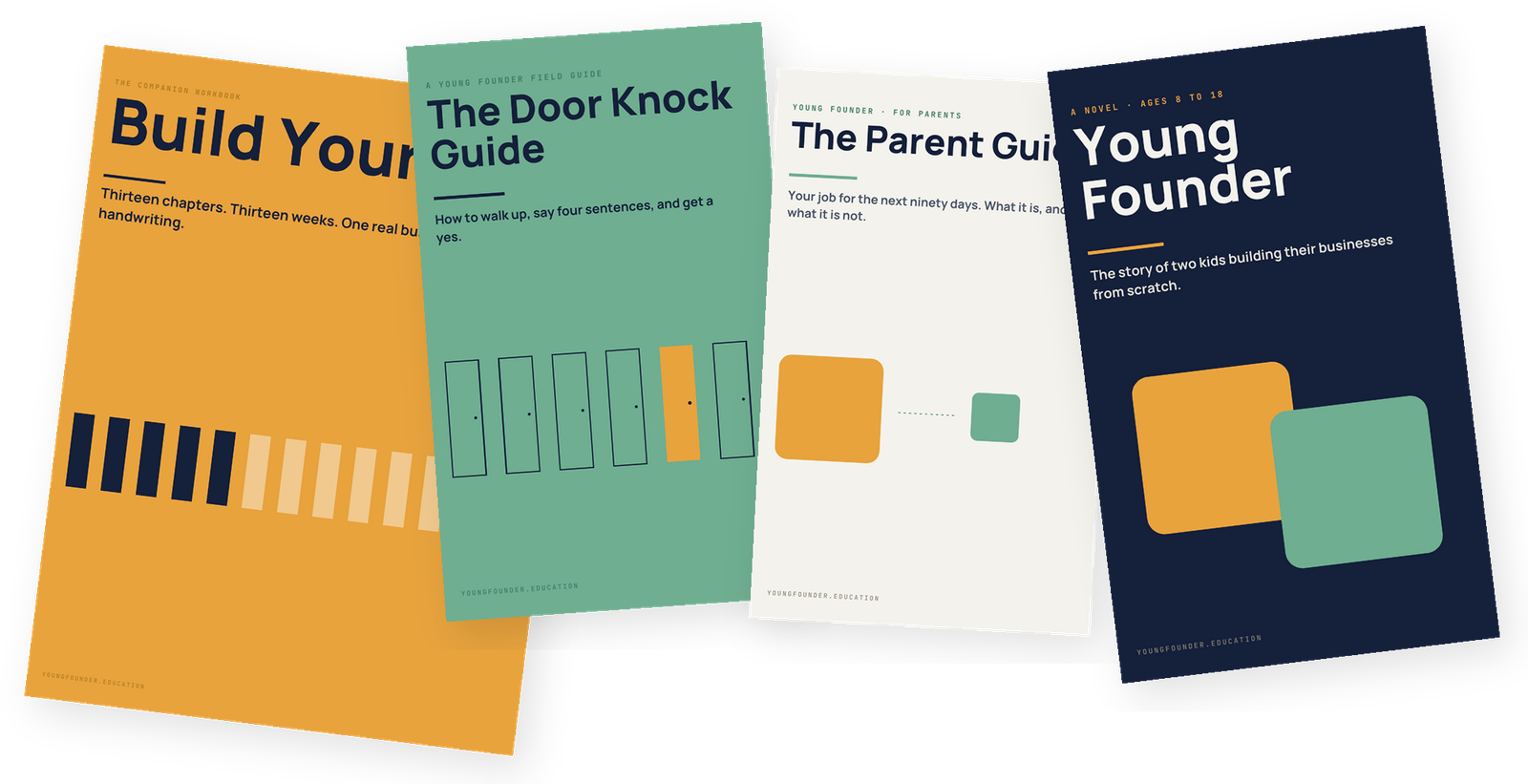
Young Founder, the novel.
Thirteen chapters about two kids building businesses from nothing. This does the teaching.
Build Yours, the workbook.
One chapter for every chapter of the novel. This is where their business actually gets built.
The Parent Guide.
Your job, week by week, including what to say the week they want to quit.
The Door Knock Guide.
How to walk up and ask a stranger for money. Four sentences that work at any door.
Twenty five idea cards.
Spread them on a table and pick one. Every card links to a full starter guide.
The paperwork.
Door logs, job tickets, receipts, week sheets. Real forms, because a kid who hands over a receipt is running a business.
The 90-day sprint map.
Thirteen weeks on one page. It goes on a wall, not in a drawer.
A first-sale certificate.
Blank until the day somebody hands them money. Then it is the best thing in the box.
WHO IT IS FOR
Eight to eighteen, and it works differently at each end.
Andre is sixteen and Sophie is twelve, so there is somebody in the book for wherever your kid is.
AGES 8 TO 10
You read it together
A co-read, and you are in the room for the money and the strangers. A nine year old earning four dollars learns exactly what a sixteen year old learns earning forty.
AGES 11 TO 13
They run it, you drive
They make the pitch and set the price, including the bad prices. You hold the money and the schedule.
AGES 14 TO 18
You are on call
It is theirs. You handle whatever genuinely needs an adult, and otherwise you are the person they think out loud with.
BEFORE YOU ORDER
The honest answers.
When does it ship, and what if you are late?
Boxes go out the first week of December for the January cohort. This is a preorder, which means we are printing the first hundred with the money you send now. If anything slips, you will hear it from us with a date, not silence. Full refund any time before it ships.
Do we have to start in January?
No, but we would push you to. A kit you can start any time is a kit that gets started never. The cohort date is the thing that makes it happen, and it is why the calls work. There are Summer and Fall cohorts if January is wrong for you.
What if my kid does not know what business to start?
That is the normal starting position and the first two chapters are about exactly that. There is also a free five-question quiz on this site that narrows twenty five ideas down to four, and you do not need to buy anything to use it.
How much of this is on me?
Less than you think, and the Parent Guide is mostly about doing less rather than more. Expect one conversation a week and a couple of drives. If your kid is under ten it is more hands-on, and there is a chapter on how to do that without taking it over.
What if we fall behind?
Every week in the Parent Guide has a section on what to do if you are behind, because most families are at some point. Thirteen weeks is a shape, not a deadline.
Do they need money to start?
No, and we would rather they did not. Every one of the twenty five ideas leads with a way to test it for free first, and the single most valuable rule in the kit is that nobody buys supplies before somebody has said yes.
THE FOUNDING COHORT
One hundred families. One start date.
Nothing they start with has to be special. Not the money, not the idea, not the connections. What they do with the next ninety days is the part that counts.
Reserve a founding spot$247, shipping included. Refundable until your box ships.
A program from Founder's Best Friend. Built for kids 8 to 18 who want something of their own.